
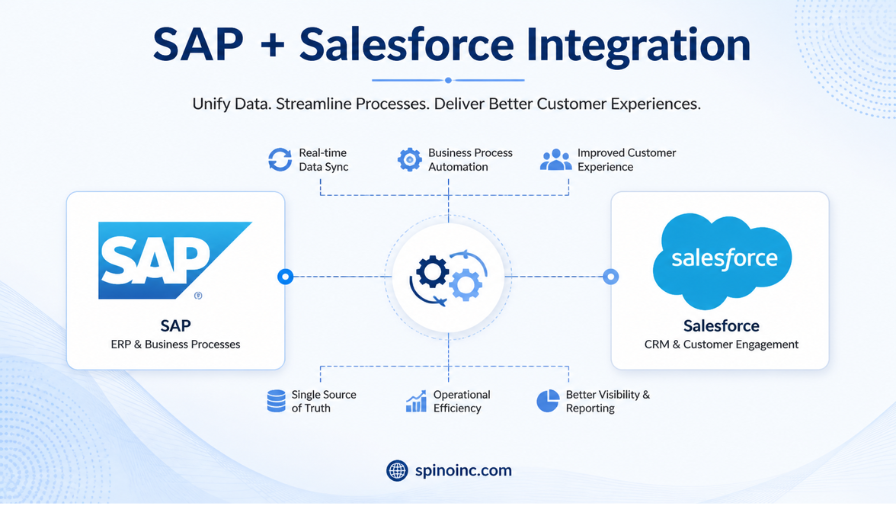
1. Executive Summary: Enterprise Lead-to-Cash Modernization via SAP Salesforce Integration Solutions
In modern high-velocity global enterprises, the operational divide between customer-facing front-office teams and transactional back-office operations represents one of the largest drains on corporate profitability. Front-office commercial representatives operate inside Salesforce CRM to manage leads, nurture customer accounts, track sales opportunities, and generate price quotes. Simultaneously, operational fulfillment, inventory management, complex billing schedules, supply chain logistics, and financial ledger accounting execute inside SAP ERP (SAP S/4HANA or SAP ECC 6.0). When these two operational engines operate in silos, commercial execution slows down: sales teams quote obsolete pricing, manual order entry introduces costly shipping errors, fulfillment tracking remains invisible to account managers, and revenue recognition stalls. Spino Inc. engineers corporate-grade SAP Salesforce Integration Solutions that eliminate system boundaries, automate end-to-end Lead-to-Cash workflows, and deliver sub-second bi-directional synchronization between Salesforce and SAP. By combining enterprise integration middleware—primarily SAP Business Technology Platform (BTP) Integration Suite and event-driven architectures—with deep transactional ERP knowledge, Spino Inc. provides enterprise organizations with an automated, synchronized digital nervous system that links pipeline generation directly to financial realization. Our integration engineering practice adheres strictly to a Clean Core Architecture. Rather than introducing invasive custom modifications (Z-tables, direct table reads, or tightly coupled ABAP programs) into your SAP digital core, Spino Inc. leverages versioned, public released APIs, enterprise message queues, and decoupled microservices. This guarantees that whether your enterprise executes millions of daily order line items, synchronizes complex Configure, Price, Quote (CPQ) bills of materials, or requires live visibility into customer credit limits, your transactional backbone remains clean, secure, and ready for future cloud upgrades. Discover our engineering capabilities on our About Spino Inc. page or explore technology career paths at Careers at Spino Inc.2. Strategic Value Drivers: Quantifiable Enterprise ROI of CRM-ERP Integration
Integrating Salesforce CRM with SAP ERP is an operational transformation that generates quantifiable financial and productivity returns across sales, finance, and operations:2.1 Complete Lead-to-Cash Cycle Compression
Manual handoffs between closed sales opportunities in Salesforce and sales order creation in SAP typically introduce 2 to 5 business days of administrative friction. Spino Inc.’s SAP Salesforce Integration Solutions automate this pathway entirely. The instant an Opportunity or Quote reaches “Closed-Won” status in Salesforce, an automated integration flow validates customer master data, checks real-time material availability, calculates dynamic tax and freight schedules, and posts a formal Sales Order into SAP S/4HANA in seconds. This compression accelerates billing, shortens Days Sales Outstanding (DSO), and improves corporate cash flow.2.2 Eradication of Manual Data Entry Errors and Order Rework
Manual re-keying of complex quotes from Salesforce into SAP transactions (such as VA01) suffers from error rates ranging between 4% and 12%, resulting in incorrect product configurations, pricing mismatches, shipping disputes, and credit memo issuance. Our automated bi-directional mapping ensures 100% data fidelity across complex multi-line orders, variant configurations, custom pricing tiers, and delivery schedules, eliminating human intervention and costly downstream dispute management.2.3 Real-Time Inventory, Pricing & Credit Limit Transparency
Sales representatives frequently lose deals or disappoint strategic clients because they lack visibility into active warehouse inventory levels or customer credit status during negotiations. Our integration surfaces SAP live ATP (Available-to-Promise) inventory quantities, customer-specific pricing conditions (PR00), dynamic discount matrices, and credit exposure metrics directly inside native Salesforce Lightning interfaces. Sales teams can quote with confidence, knowing stock is reserved and financial credit boundaries are respected.2.4 360-Degree Operational & Financial Customer Visibility
Post-sale customer satisfaction hinges on proactive communication. By synchronizing SAP fulfillment data—such as outbound delivery numbers, carrier tracking codes, shipment milestones, serial numbers, invoice statuses, and payment receipts—back into Salesforce, account executives and customer support agents resolve customer inquiries instantly without submitting internal tickets to back-office supply chain teams.3. Core Enterprise Integration Workflows & Business Scenarios
Spino Inc. designs and deploys robust, pre-packaged and bespoke integration patterns tailored to complex enterprise commercial models:A. Bi-Directional Account & Customer Master Synchronization
Customer master records must remain synchronized across both platforms. Spino Inc. implements bi-directional synchronization aligning Salesforce Accounts with the SAP Business Partner (BP) data model (Customer, Vendor, and Contact roles). Our integration orchestrates multi-address structures, tax classification codes, credit control areas, payment terms, and reconciliation accounts, utilizing automated deduplication and survivorship algorithms to ensure neither system creates orphan records.B. Product Catalog & Material Master Replication (MM to Salesforce Products)
Maintaining product catalogs across disparate platforms is a recurring challenge. Spino Inc. engineers automated one-way scheduled and event-triggered synchronization from the SAP Material Master (MARA/MARC/MBEW) into Salesforce Products (Product2) and Price Books. This includes synchronizing product hierarchies, units of measure (UoM), active sales organizations, plant-specific statuses, and localized currency rate tiers.C. Salesforce CPQ to SAP S/4HANA Advanced Order Orchestration
For organizations selling complex, engineered-to-order, or multi-attribute products, Salesforce CPQ manages complex quote generation while SAP handles manufacturing execution. We integrate Salesforce CPQ Quote Lines with SAP Sales Orders and Variant Configuration (LO-VC), mapping bundle parent-child relationships, bill-of-materials (BOM) components, and pricing condition contracts directly into standard SAP sales document structures (BAPIs and OData APIs).D. Live SAP Pricing & ATP Simulation within Salesforce
Rather than duplicating complex SAP pricing logic inside Salesforce, Spino Inc. utilizes synchronous API calls to SAP’s Sales Order Simulation engine. While building a quote in Salesforce, a representative clicks “Calculate Pricing”; the system sends the draft line items to SAP, which computes customer discounts, surcharge conditions, tax calculations, and warehouse delivery dates, returning the certified values to the Salesforce screen in sub-second response times.E. Invoice, Billing & Payment Status Synchronization
Once products are shipped and billed in SAP (via SD billing documents or FI-CA), financial statuses sync back to Salesforce. Account teams gain visibility into open invoice amounts, payment due dates, cleared transactions, and historical billing documents, empowering commercial teams to actively support accounts receivable collections.4. Technical Architecture: Decoupled, Event-Driven Clean Core Integration
Enterprise integrations must remain resilient against network latency, API rate limits, and system maintenance windows. Spino Inc. deploys a decoupled, three-tier architecture utilizing enterprise middleware:| Architecture Layer | Core Technologies & Standards | Operational Responsibility & Design Function |
|---|---|---|
| 1. Front-Office Presentation & CRM | Salesforce Sales Cloud, Service Cloud, Revenue Cloud (CPQ), Platform Events, Change Data Capture (CDC) | Captures customer interactions, manages pipeline stages, generates pricing quotes, publishes real-time business events, and displays ERP transactional data via native Lightning Web Components (LWC). |
| 2. Enterprise Integration Middleware | SAP BTP Integration Suite (Cloud Integration/CPI), Event Mesh, API Management, MuleSoft / Boomi Connectors | Manages protocol mediation (REST to SOAP/OData), data payload transformation, OAuth 2.0 token security, queuing, retry logic, dead-letter monitoring, and bi-directional message routing. |
| 3. Enterprise ERP & Fulfillment Core | SAP S/4HANA Cloud (Public/Private), SAP ECC 6.0, OData V2/V4 APIs, ABAP RAP, Business Partner Data Model | Executes sales order fulfillment, credit limit verification, inventory reservations (ATP), manufacturing scheduling, billing document generation, and financial accounting while keeping the digital core clean. |
5. Technical Comparison: Point-to-Point Custom Coding vs. Spino Inc. Modern Enterprise Integration
| Integration Dimension | Legacy Point-to-Point Custom Code (Hardcoded ABAP / Apex) | Spino Inc. SAP Salesforce Integration Solutions |
|---|---|---|
| Architecture Topology | Direct point-to-point connections; tightly coupled systems with high interdependency. | Decoupled, event-driven middleware architecture utilizing SAP BTP Integration Suite. |
| Upgrade & Clean Core Impact | Invasive Z-tables and custom modifications break during SAP or Salesforce release upgrades. | 100% upgrade-stable Clean Core design consuming public versioned APIs and standard schemas. |
| Error Handling & Resilience | Silent transaction failures; dropped messages during maintenance; complex manual log audits. | Automated message queuing, persistent retry mechanisms, dead-letter queues, and real-time alerts. |
| Performance & API Governance | Risk of hitting Salesforce daily API limits; synchronous calls degrade user UI responsiveness. | Asynchronous bulk data handling, payload compression, and centralized API governance. |
| Data Validation & Mapping | Hardcoded mapping scripts; modifying fields requires code changes, deployments, and testing. | Visual graphical mapping, pre-built integration content, and dynamic lookup tables. |
| Security & Encryption | Hardcoded service account credentials; vulnerable point-to-point perimeter endpoints. | End-to-end TLS 1.3 encryption, mutual authentication (mTLS), SAML 2.0, and OAuth 2.0 security. |
6. Real-World Enterprise Implementation Case Studies
Case Study 1: Global Industrial Equipment Manufacturer – CPQ to SAP S/4HANA Order Automation
- Enterprise Profile: Multi-billion dollar heavy equipment manufacturer with 1,200 international sales representatives across North America and Europe.
- Challenge: The client configured complex engineered-to-order machinery in Salesforce CPQ. Due to disconnected systems, sales quotes were manually re-keyed by an order entry team into SAP S/4HANA. The process took an average of 4 business days per quote, with an error rate of 8.5% that resulted in millions of dollars in manufacturing rework and delayed shipments.
- Spino Inc. Solution: Spino Inc. architected an automated Lead-to-Cash integration pipeline using SAP BTP Integration Suite and Salesforce Platform Events. When a quote reaches “Contract Signed,” an asynchronous event publishes to SAP BTP, triggering automated BOM expansion, pricing verification, and direct order creation via standard SAP OData APIs. In addition, real-time SAP ATP inventory checks were embedded directly into the Salesforce CPQ quoting interface.
- Business Impact: Order creation turnaround dropped from 4 days to under 45 seconds; order entry errors were reduced to 0%; order processing labor costs decreased by $1.8M annually; and sales representative quoting velocity increased by 35%.
Case Study 2: Fast-Growing Medical Devices Distributor – Omnichannel Master Data & Invoice Visibility
- Enterprise Profile: High-growth healthcare logistics distributor managing 45,000 hospital customer accounts across North America.
- Challenge: Account managers inside Salesforce lacked visibility into customer credit balances, delivery tracking, and invoice payments residing in SAP ECC. Customer service representatives spent up to 35% of their daily working hours fielding phone calls from sales reps inquiring about delivery dates and credit holds.
- Spino Inc. Solution: Spino Inc. engineered a bi-directional data synchronization pipeline connecting Salesforce Service Cloud with SAP ECC via decoupled REST APIs and enterprise message queues. We synchronized Accounts with SAP Business Partners, exposed live outbound shipment tracking data within Salesforce Lightning pages, and synchronized financial invoice clearing statuses daily.
- Business Impact: Internal status inquiry tickets dropped by 82%; average customer support resolution time decreased by 60%; Days Sales Outstanding (DSO) improved by 6.2 days through automated visibility of overdue invoices; and customer master data accuracy reached 99.8%.
7. FAQs: SAP Salesforce Integration Solutions
Q1: What are the primary middleware options for integrating SAP with Salesforce?
Answer: The leading enterprise middleware solutions include SAP BTP Integration Suite (Cloud Integration/CPI), MuleSoft Anypoint Platform, and Boomi. Spino Inc. specializes in SAP BTP Integration Suite, as it provides native pre-packaged integration content, out-of-the-box SAP business adapters, and strict compliance with SAP clean core standards, while also supporting multi-vendor middleware environments.Q2: How does Spino Inc. prevent hitting Salesforce daily API governor limits?
Answer: We implement intelligent architectural patterns: (1) using asynchronous batch and bulk APIs for large-scale data transfers, (2) event-driven messaging using Salesforce Platform Events and Change Data Capture (CDC) to transmit only delta modifications, and (3) real-time data virtualization and caching via OData and SAP BTP to avoid unnecessary data polling.Q3: What is the recommended strategy for Customer Master synchronization?
Answer: We recommend establishing a “Golden Record” ownership policy. Typically, Salesforce acts as the master for Leads and Prospect accounts during the commercial stage. Once an account converts to an active customer, SAP assumes master ownership for formal financial parameters (tax classifications, credit terms, and payment terms), with bi-directional synchronization updating shared data fields across both platforms.Q4: How does the integration handle complex SAP Variant Configuration (LO-VC) in Salesforce CPQ?
Answer: Spino Inc. maps Salesforce CPQ configuration attributes directly to SAP Variant Configuration characteristic values. During the quoting process, an automated API call invokes the SAP configuration engine to validate characteristic dependencies and constraints, ensuring that every quote created in Salesforce produces a valid, manufacturable Bill of Materials (BOM) in SAP.Q5: Can sales representatives check live SAP inventory availability directly from Salesforce?
Answer: Yes. By establishing synchronous API calls from Salesforce Lightning Web Components (LWC) into SAP S/4HANA via SAP BTP Integration Suite, sales reps can click “Check Stock” on an Opportunity or Quote to view real-time Available-to-Promise (ATP) quantities across specific plants and storage locations without data replication.Q6: What happens if SAP or Salesforce experiences a scheduled maintenance outage?
Answer: Spino Inc. builds decoupled, asynchronous architectures with guaranteed message delivery. Transactions generated during an outage are safely buffered inside message queues (such as SAP Event Mesh or JMS queues). Once the target system returns online, the middleware replays the queued messages in chronological order with zero data loss.Q7: How does Spino Inc. handle pricing condition logic synchronization?
Answer: Because enterprise pricing matrices in SAP involve complex pricing schemas (pricing procedures, access sequences, customer-specific discounts, and surcharges), we avoid duplicating this code in Salesforce. Instead, we implement synchronous calls to the SAP Sales Order Simulation API, which returns accurate pricing, tax, and freight calculations to Salesforce in sub-second response times.Q8: Is it better to use real-time synchronization or batch scheduled jobs?
Answer: We employ a hybrid strategy. Transaction-critical workflows—such as Order Creation, Pricing Simulation, and ATP Checks—execute in real time via event-driven messaging. High-volume, non-time-sensitive data—such as nightly product master catalog updates and historical invoice archives—process via scheduled micro-batches to conserve system compute and API limits.Q9: How are data security, encryption, and compliance maintained?
Answer: All data in transit is protected using TLS 1.3 encryption and mutual authentication (mTLS). We enforce OAuth 2.0 token-based authorization with role-based scope restrictions, ensuring that intermediate middleware services never store unencrypted personal identifiable information (PII), supporting GDPR, CCPA, and SOC 2 Type II compliance.Q10: What is the typical implementation timeline for an enterprise SAP-Salesforce integration?
Answer: A focused implementation—such as bi-directional Account and Contact synchronization combined with basic Order creation—typically spans 6 to 10 weeks. Comprehensive Lead-to-Cash deployments—including Salesforce CPQ, Variant Configuration, live pricing simulations, and invoice status syncing—generally take 12 to 18 weeks including end-to-end User Acceptance Testing (UAT).Q11: Can legacy SAP ECC 6.0 systems be integrated with modern Salesforce Cloud?
Answer: Yes. Spino Inc. integrates legacy SAP ECC 6.0 environments (both on AnyDB and HANA) using standard BAPIs, IDocs, and RFCs exposed via SAP NetWeaver Gateway or SAP BTP Cloud Connector. We build integrations so that when you eventually migrate from ECC to S/4HANA, the Salesforce interface remains stable.Q12: How does Spino Inc. manage data deduplication between CRM and ERP?
Answer: We implement cross-system identity mapping tables stored in enterprise integration middleware. Before inserting any new record, the middleware evaluates unique external identifiers (such as Tax Identification Numbers, D-U-N-S numbers, or standardized email domains) to match existing records and avoid creating duplicate customer accounts.Q13: What role does SAP Business Technology Platform (BTP) play in the integration?
Answer: SAP BTP serves as the central integration and extensibility layer. Through SAP Integration Suite, BTP manages API connections, data transformations, security token issuance, and event-driven message queuing, ensuring that customizations are decoupled from the SAP S/4HANA core in alignment with clean core architecture principles.Q14: What is Change Data Capture (CDC) and how is it utilized?
Answer: Change Data Capture is an event-driven mechanism in Salesforce that publishes notifications whenever a record is created, updated, or deleted. Spino Inc. captures these event streams in real time via SAP BTP, allowing immediate processing of relevant modifications without executing intensive database polling queries.Q15: Can customer credit check holds be displayed in Salesforce?
Answer: Yes. Our integration queries SAP Credit Management (FSCM) in real time. If an account exceeds its authorized credit limit or has overdue invoices, the integration displays a visual indicator inside Salesforce, preventing the sales rep from finalizing a quote until credit approval is granted by finance.Q16: How does Spino Inc. monitor integration health and resolve errors in production?
Answer: We configure automated monitoring dashboards within SAP BTP and Salesforce. If a message fails validation (e.g., missing postal code or invalid tax jurisdiction), the error is logged into an automated exception queue, an alert notification is dispatched to technical administrators, and the failed transaction can be reprocessed directly from an admin console once corrected.Q17: How are custom fields in Salesforce and custom Z-fields in SAP handled?
Answer: We configure flexible data mapping schemas inside SAP BTP Integration Suite. When business processes require custom fields, our architects map these fields to appropriate extension structures (such as BAPI extension parameters or released OData extension fields) without modifying core ERP programming.Q18: What is the difference between synchronous and asynchronous integration patterns?
Answer: Synchronous integration requires the calling system to wait for an immediate response (ideal for live pricing calls and stock checks). Asynchronous integration dispatches a message into a queue and allows the user to continue working immediately, while the backend processes the transaction in the background (ideal for heavy order creation and invoice sync).Q19: How are multi-currency and international tax conversions managed across systems?
Answer: We establish standardized synchronization schedules for currency exchange rates, replicating corporate rates from SAP (TCURR) into Salesforce Currency tables. Tax calculations are handled either by delegating the tax calculation to SAP’s internal engine or integrating external tax compliance engines (such as Vertex or Avalara) across both platforms.Q20: Can Salesforce Service Cloud agents initiate returns or credit memos in SAP?
Answer: Yes. We engineer customer service integration workflows allowing authenticated Service Cloud agents to initiate Return Material Authorizations (RMA) or draft credit memo requests directly from a Salesforce case record, which routes into SAP for warehouse return processing and financial validation.Q21: Does Spino Inc. provide pre-built integration templates?
Answer: Yes. We maintain an enterprise library of pre-configured integration packages for standard workflows—including Account-Business Partner Sync, Material-Product Sync, Order Creation, and Invoice Tracking—which accelerates project timelines and reduces initial engineering costs by up to 40%.Q22: How does the integration support a “Clean Core” SAP ERP roadmap?
Answer: By executing all data mapping, business transformation rules, and protocol translations inside intermediate middleware (SAP BTP) and interacting with SAP exclusively through public released APIs, the ERP core remains unmodified, allowing automated cloud release updates to proceed without integration downtime.Q23: How are deletion events synchronized across platforms?
Answer: To prevent accidental data loss, we enforce soft deletion and archiving policies. If a record is deleted or deactivated in Salesforce, the integration updates the corresponding SAP record with an archiving flag or deactivation status rather than executing a hard database purge.Q24: Why should an enterprise engage Spino Inc. rather than building the integration in-house?
Answer: In-house IT teams often specialize in either Salesforce or SAP, but rarely possess senior cross-domain mastery in both ecosystems. Spino Inc. provides dual-certified architecture teams who understand Salesforce apex frameworks and deep SAP functional tables, ensuring a robust, secure, and production-tested deployment.Q25: How does an organization initiate an SAP Salesforce Integration consultation with Spino Inc.?
Answer: You can schedule an initial Architectural Discovery Workshop by reaching out through our Contact Spino Inc. Page or contacting our global delivery teams directly.8. Corporate Directory & Global Integration Delivery Centers
Spino Inc. delivers round-the-clock enterprise integration advisory, implementation engineering, and managed operations across North America and Asia-Pacific delivery centers:- Corporate Website: https://spinoinc.com
- SAP Solutions Portfolio: https://spinoinc.com/sap-solutions/
- Integration Solutions Hub: https://spinoinc.com/sap-solutions/sap-salesforce-integration/
- Enterprise Contact Portal: https://spinoinc.com/contact/
- Primary Inquiries Email: info@spinoinc.com
Global Office Locations
🇺🇸
USA Headquarters
Monmouth Junction, NJ
1100 Cornwall Rd, Suite #221
Monmouth Junction, NJ 08852, USA
Primary Focus: Strategic Enterprise Architecture, Global Partner Governance, North American Client Operations
🇺🇸
USA Midwest Office
Cincinnati, Ohio
Columbia Plaza, 250 East Fifth Street
15th Floor, Cincinnati, Ohio 45202, USA
Primary Focus: Industrial Supply Chain Automation, Complex CPQ Orchestration, Cloud FinOps Advisory
🇮🇳
India Delivery Center
Hyderabad, Telangana
ARKA Heights, 1st Floor, Plot No 125 & 126, Beside Preston Prime Mall, Lumbini Avenue, Gachibowli, Hyderabad 500032, India
Center Hours: Mon – Sat: 9:00 AM – 3:00 AM IST
(Continuous 24-hour overlap with US Eastern, Central & Pacific time zones)