
Strategic SAP S/4HANA Migration & Implementation Services: Modernizing the Enterprise Digital Core
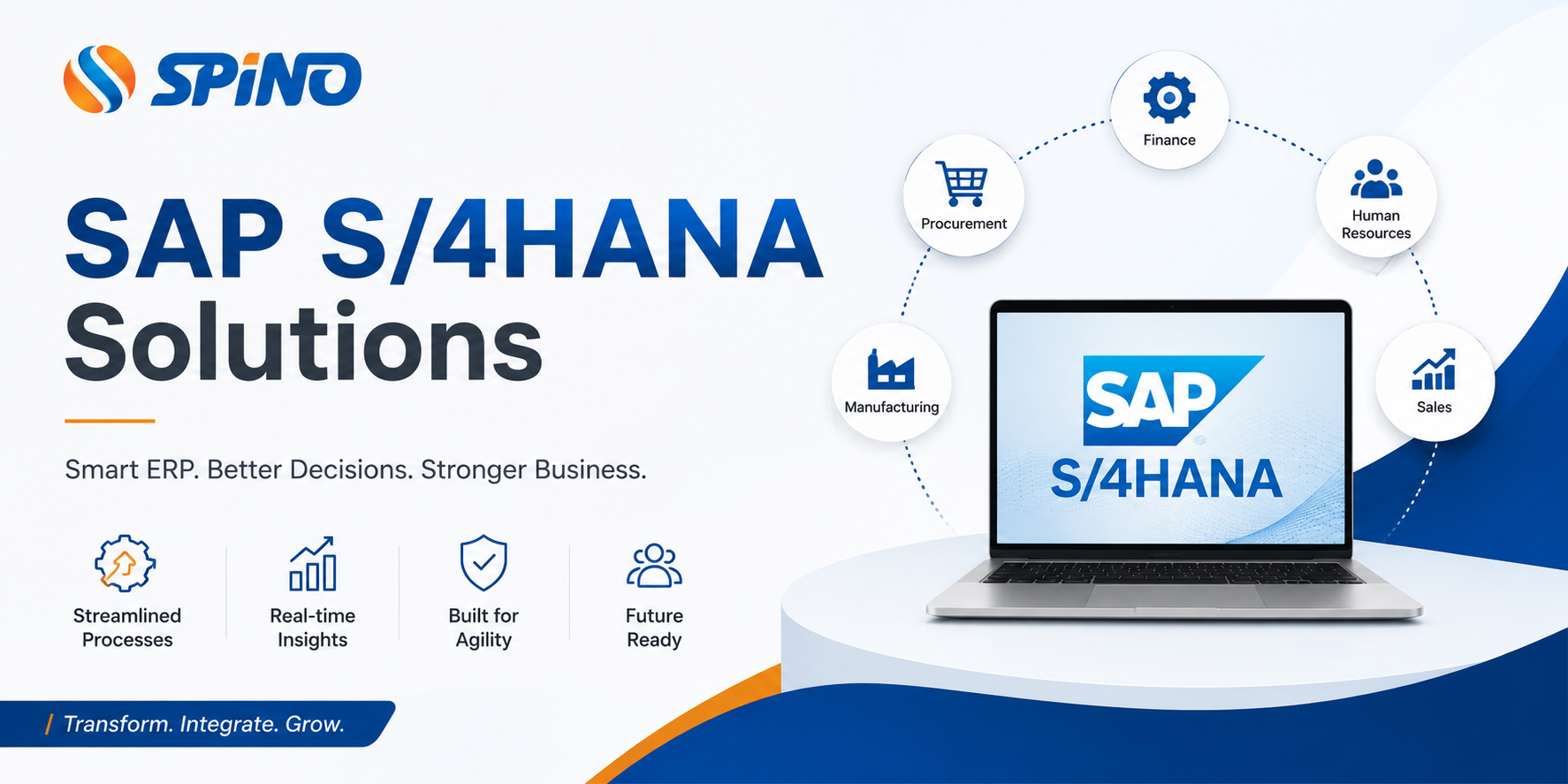
In an era defined by volatility, real-time demand shifts, and unprecedented technological disruption, modern enterprises can no longer rely on legacy legacy architectures. The global deadline for SAP ECC support is driving enterprise leaders to evaluate their core business systems. At Spino Inc, we approach SAP S/4HANA Migration & Implementation not merely as an IT infrastructure upgrade, but as a holistic strategic initiative to convert your business into an agile, data-driven, intelligent enterprise.
Transitioning to SAP S/4HANA unlocks the massive computational capabilities of the SAP HANA in-memory database. By eliminating aggregate data tables, streamlining business process workflows, and replacing fragmented transactional screens with modern SAP Fiori user experiences, SAP S/4HANA provides the foundation required for true operational scalability.
The Strategic Imperative: Why Transition from SAP ECC to SAP S/4HANA?
Legacy SAP ERP Central Component (ECC) systems were architected for an era of batch processing, physical database constraints, and siloed data stores. Modern competitive advantages demand real-time visibility, automated decision-making, and seamless cross-platform connectivity.
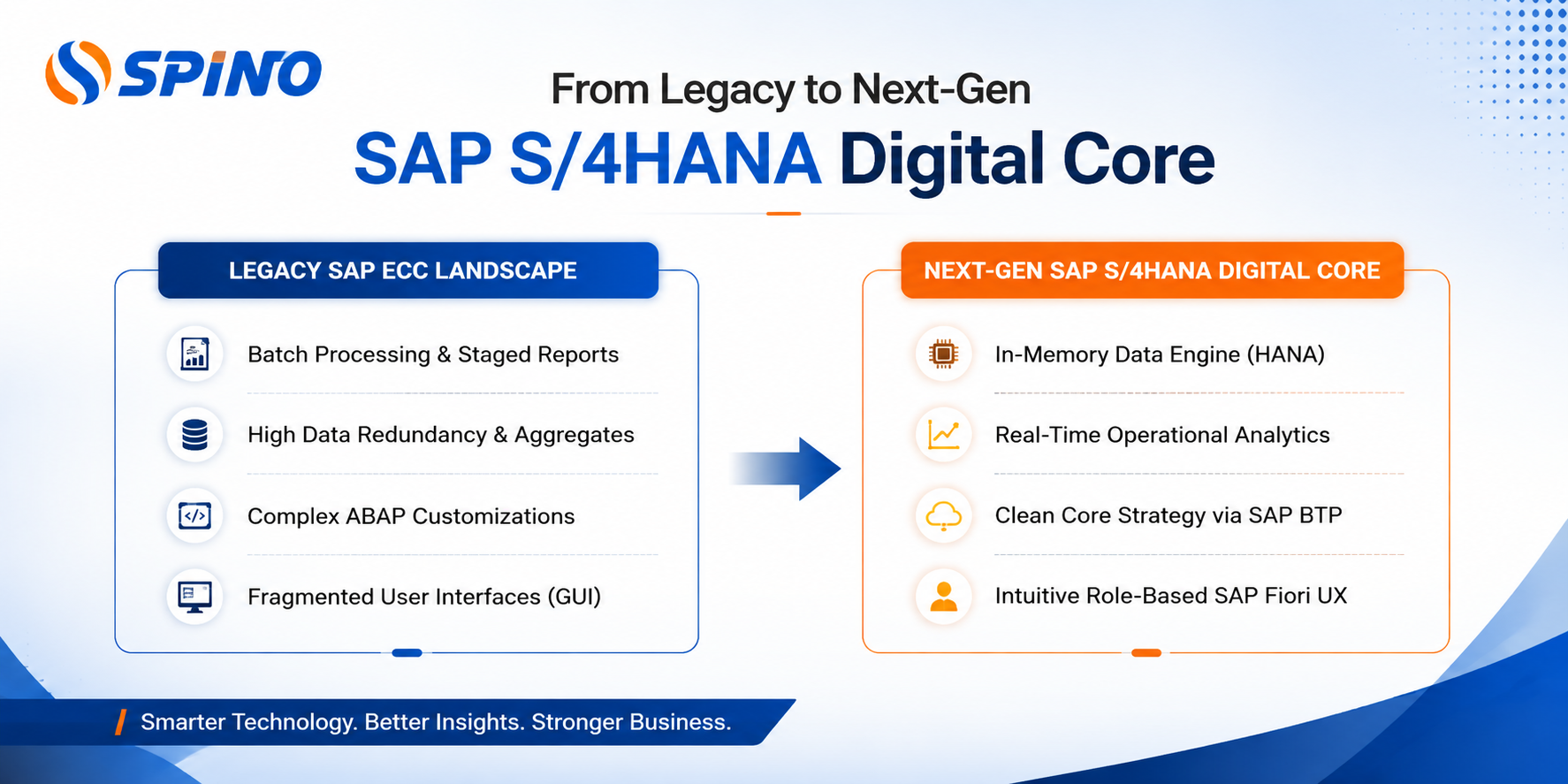
Moving to SAP S/4HANA directly resolves structural bottlenecks in legacy systems:
-
Elimination of Data Aggregates and Redundancies: In legacy database designs, summary tables were required to run financial and inventory reports efficiently. SAP S/4HANA calculates aggregates on-the-fly directly from transactional line items, drastically reducing total database footprint.
-
Unified Financial Data (Universal Journal – ACDOCA): Financial Accounting (FI) and Controlling (CO) data streams are unified into a single source of truth—the
ACDOCAtable. This eliminates tedious end-of-month reconciliations and delivers continuous closing capabilities. -
Real-Time Material Requirements Planning (MRP Live): Traditional MRP processing runs overnight as batch jobs. With S/4HANA, MRP Live runs in real time, calculating supply shortages across thousands of materials in seconds.
-
Predictive Machine Learning & Embedded AI: Intelligent algorithms natively embedded into business workflows anticipate inventory stockouts, automate payment matching, and optimize asset maintenance.
Evaluating Deployment Pathways: Greenfield, Brownfield, or Selective Data Transition
Choosing the proper execution pathway dictates project timelines, resource allocation, and organizational change dynamics. At Spino Inc, we analyze your legacy code density, historical data value, and business process maturity to guide you through three primary migration methodologies:
1. Greenfield Approach (New Implementation)
A Greenfield execution involves building an entirely new SAP S/4HANA environment from scratch. Legacy configurations, obsolete ABAP modifications, and historical transactional clutter are left behind.
-
Strategic Focus: Complete operational re-engineering and standardization against predefined SAP Best Practices.
-
Key Advantages: Clean database architecture, high alignment with out-of-the-box standard functionality, zero legacy technical debt, simplified future updates.
-
Primary Drawbacks: Higher project scope, extended change management requirements, complete end-user retraining.
-
Ideal For: Organizations with heavily modified legacy environments, non-SAP ERP legacy systems, or businesses seeking complete process transformation.
2. Brownfield Approach (System Conversion)
A Brownfield conversion converts an existing operational SAP ECC system directly into SAP S/4HANA in-place, preserving your current configuration settings, custom extensions, and historical business data.
-
Strategic Focus: Technical migration and platform modernization with minimal process disruption.
-
Key Advantages: Preserves historical business history, shorter overall project execution timelines, reduced end-user retraining needs, cost-optimized initial path.
-
Primary Drawbacks: Carries forward legacy technical debt, retains obsolete ABAP code, limits immediate adoption of standardized best practices.
-
Ideal For: Companies with well-structured, highly compliant SAP ECC setups that want to modernize infrastructure while preserving decades of operational data history.
3. Selective Data Transition (Hybrid Approach)
Selective Data Transition (SDT) balances Greenfield and Brownfield models by creating a clean SAP S/4HANA core while selectively transferring targeted master data, organizational units, and historical open items.
-
Strategic Focus: Flexible data migration combined with modular process redesign.
-
Key Advantages: Allows selective historical data retention, enables corporate restructuring or divestiture management, mitigates global system conversion risks.
-
Primary Drawbacks: Requires specialized ETL data migration tooling, complex scoping workshops, higher initial data mapping investment.
-
Ideal For: Enterprise groups consolidating multiple legacy ERP instances, executing corporate spin-offs, or modernizing specific business units iteratively.
Detailed Comparative Analysis Matrix
| Feature / Metric | Greenfield Implementation | Brownfield Conversion | Selective Data Transition (Hybrid) |
| System Architecture | Built fresh from ground up | Direct in-place system conversion | Clean build with selective data loads |
| Business Process Change | High (Complete Re-engineering) | Low (Preserves existing models) | Medium (Targeted optimization) |
| Historical Data Retention | Master data & open items only | Full historical transactional data | Customized (Selective historical data) |
| Custom Code Retention | Minimal (Clean Core focus) | High (Requires code remediation) | Selective (Only active business logic) |
| Average Timeline | 10 to 18 Months | 4 to 9 Months | 8 to 14 Months |
| Risk & Change Overhead | High Change Management needed | Low operational disruption | Managed modular risk profiles |
Comprehensive Implementation Framework: The SAP Activate Methodology
To eliminate implementation risks and guarantee project execution quality, Spino Inc structures every project around the six structured phases of the SAP Activate Methodology:
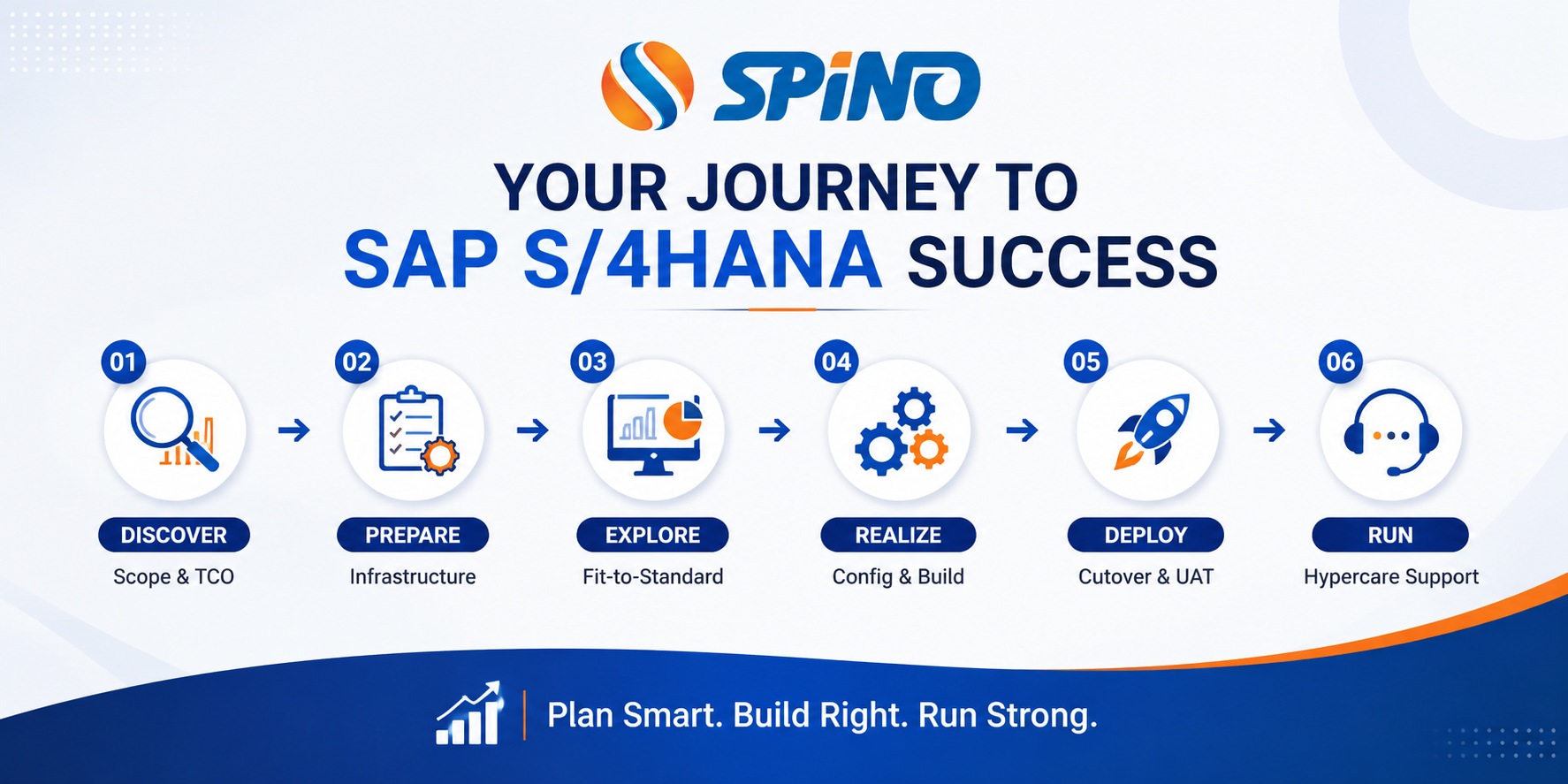
Phase 1: Discover
The project begins by validating software capabilities against business goals. We run automated assessment utilities, including the SAP Readiness Check and ABAP Test Cockpit, analyzing legacy system custom developments, add-on compatibility, and database sizing requirements.
Phase 2: Prepare
Project governance, execution standards, and initial cloud environments are established. Key deliverables include project team charters, work breakdown structures (WBS), cutover strategy drafts, and baseline system provisioning (whether via RISE with SAP, AWS, Azure, GCP, or On-Premise infrastructure).
Phase 3: Explore
Instead of traditional, time-consuming blueprinting, our consultants lead Fit-to-Standard Workshops. We showcase standard SAP S/4HANA business processes to your business unit leaders, identifying functional gaps and documenting true custom requirements in a structured Project Backlog.
Phase 4: Realize
Iterative agile development sprints commence. Business configurations, custom extensions built on SAP Business Technology Platform (BTP), interface connectors, data migration load scripts, and role-based authorizations are configured and validated through rigorous testing cycles.
Phase 5: Deploy
Final readiness validation takes place. End-user training courses are conducted, mock cutovers ensure system readiness, and final delta data migration runs during the scheduled cutover downtime window prior to formal Go-Live production release.
Phase 6: Run & Continuous Optimization
Following Go-Live, Spino Inc provides hypercare support to ensure system stability, user adoption, ongoing operational monitoring, and baseline establishment for continuous business process improvements.
Clean Core Strategy & Decoupled Customizations via SAP BTP
A common failure point in legacy SAP ECC implementations was deep, custom modification of standard ABAP source code (known as Z-code bloat). Over years of operation, these modifications make upgrades complex and expensive.
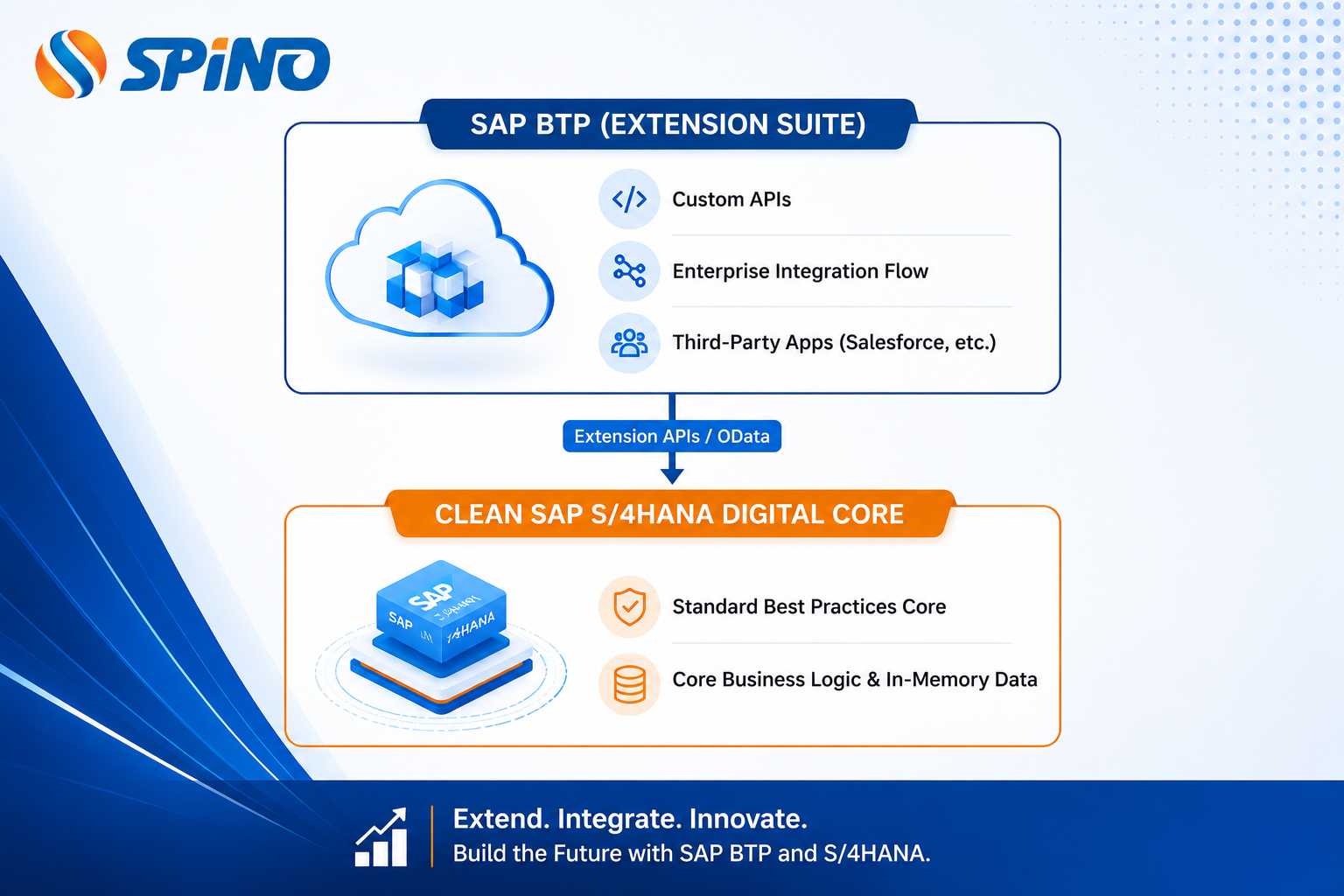
Spino Inc strictly enforces a Clean Core Strategy:
-
Side-by-Side Extensions: All novel business logic, custom web/mobile applications, and partner integrations are deployed externally on the SAP Business Technology Platform (BTP).
-
Standard Extension APIs: Applications communicate with the core S/4HANA engine via standard OData services and RESTful APIs.
-
Frictionless Upgrades: Because standard core code remains untouched, future SAP cloud updates and annual software release upgrades execute smoothly without breaking enterprise customizations.
Integrated Enterprise Architecture: S/4HANA Ecosystem Connectivity
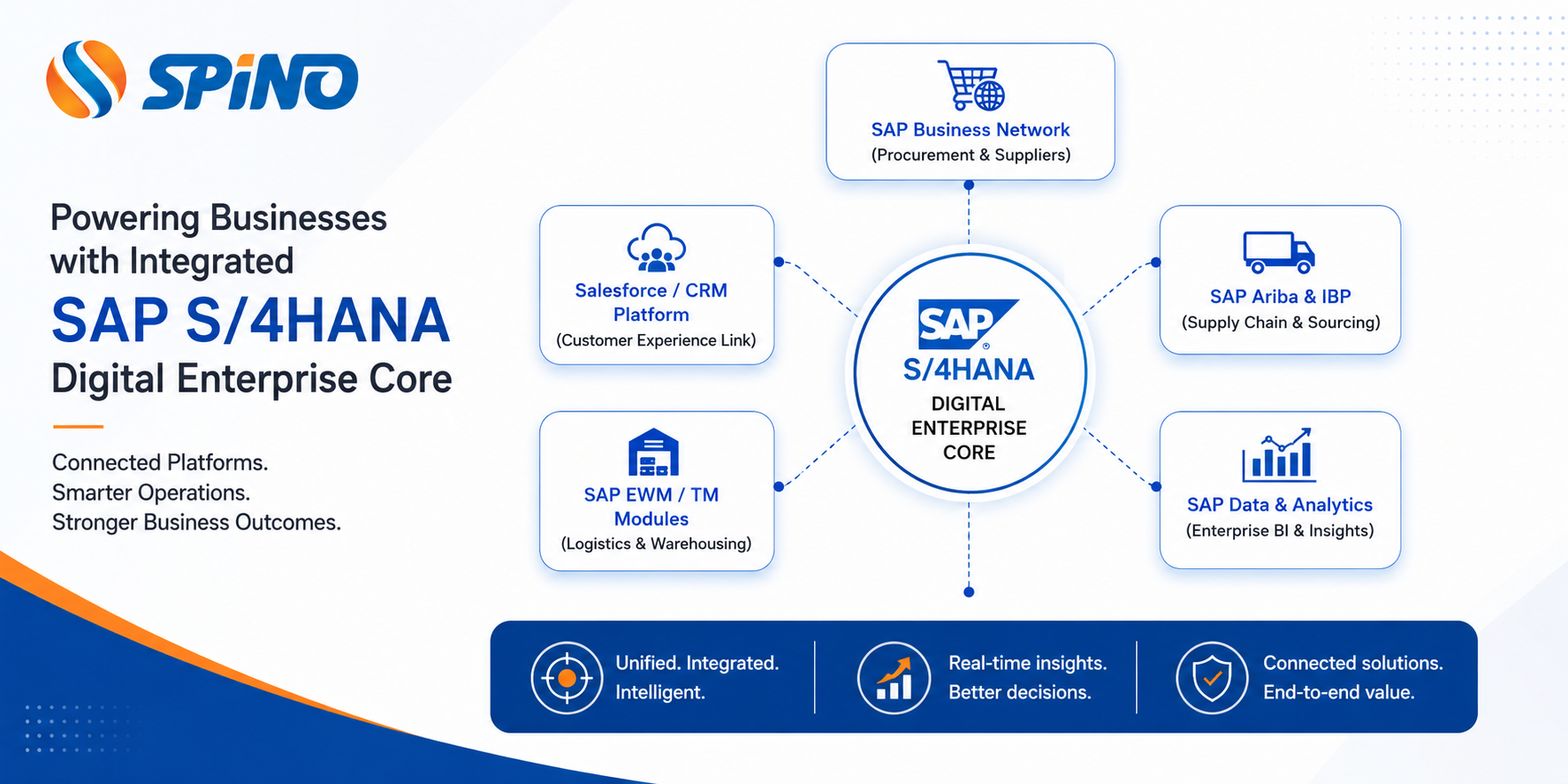
SAP S/4HANA does not operate in isolation. It acts as the central hub connecting core operational workflows, extended supply chain systems, and external cloud solutions across your ecosystem.
-
Core Logistics & Supply Chain Modules: Direct integration with SAP MM (Materials Management), SAP SD (Sales & Distribution), SAP PP (Production Planning), SAP QM (Quality Management), SAP EWM (Extended Warehouse Management), SAP TM (Transportation Management), and SAP IBP (Integrated Business Planning).
-
External Ecosystem Connectivity: Synchronizing customer relationship pipelines with Salesforce, procurement processes via SAP Ariba, supplier networks via SAP Business Network, and advanced reporting via SAP Data & Analytics.
Frequently Asked Questions (FAQs)
1. What is SAP S/4HANA Migration & Implementation?
It is the end-to-end technical, operational, and organizational journey of transitioning an enterprise from legacy ERP platforms (such as SAP ECC or non-SAP environments) to the SAP S/4HANA suite. The process encompasses system architecture redesign, custom code remediation, data conversion, process optimization, user experience modernization, and deployment across cloud or on-premise infrastructure.
2. Why is moving to SAP S/4HANA mandatory for legacy SAP ECC users?
SAP has established the sunset timeline for legacy SAP ECC maintenance support. Beyond this timeframe, maintaining older systems presents increasing security, compliance, and operational risks. Transitioning to SAP S/4HANA is required to maintain platform vendor support, access modern cloud functionality, and build real-time digital operational capabilities.
3. What is the fundamental difference between Greenfield and Brownfield approaches?
A Greenfield implementation is a completely fresh system build where business processes are re-engineered using SAP Best Practices templates, leaving legacy code and historical data behind. A Brownfield conversion is an in-place conversion that upgrades the existing SAP ECC platform to S/4HANA, preserving legacy system setup, custom code, and complete historical data records.
4. What is Selective Data Transition, and when should it be utilized?
Selective Data Transition (SDT) is a hybrid approach combining benefits of Greenfield and Brownfield strategies. It allows an enterprise to build a new target S/4HANA environment while selectively migrating specific master data, company code entities, and chosen historical open items using specialized data transformation tooling. It is ideally suited for complex enterprises, multi-ERP consolidations, or corporate divestitures.
5. How long does a standard SAP S/4HANA migration project take to execute?
Project timelines depend heavily on system size, custom code volume, organizational scope, and execution strategy. Typically, Brownfield conversions for mid-sized enterprises take between 4 to 9 months, while complex multi-entity Greenfield implementations or Selective Data Transitions range from 9 to 18 months.
6. What is the SAP Readiness Check tool, and what insights does it provide?
The SAP Readiness Check is an automated diagnostic utility executed on legacy SAP ECC environments during the Discover phase. It generates detailed technical reports covering custom ABAP code compatibility, database memory sizing, mandatory business function changes, active add-on compatibility, and user interface migration requirements.
7. How does SAP S/4HANA improve processing speed compared to legacy databases?
SAP S/4HANA runs natively on the SAP HANA in-memory database platform. By storing data in columnar structures inside random-access memory (RAM) rather than traditional disk-based relational storage, data read speeds are drastically accelerated, enabling dynamic, real-time calculations without requiring aggregate pre-built data tables.
8. What is the Universal Journal (ACDOCA) in S/4HANA Financials?
The Universal Journal is a unified financial database architecture in S/4HANA that merges Financial Accounting (FI), General Ledger (FI-GL), Asset Accounting (FI-AA), Controlling (CO), and Material Ledger (CO-PC-ACT) data into a single operational repository table (ACDOCA). This design eliminates the need for inter-module reconciliation tasks and enables real-time financial reporting.
9. What is a “Clean Core” strategy, and why is Spino Inc committed to it?
A Clean Core strategy keeps the standard SAP software base un-modified while building custom extensions, third-party integrations, and unique business applications on side-by-side platforms like the SAP Business Technology Platform (BTP). Spino Inc uses this strategy to ensure customers can apply future annual SAP upgrades seamlessly without breaking custom business applications.
10. How does the SAP Activate Methodology structure project execution?
SAP Activate is an agile, iterative implementation methodology built around six structured phases: Discover, Prepare, Explore, Realize, Deploy, and Run. It leverages pre-configured SAP Best Practices, guided project tools, and sprint-based development cycles to manage delivery timelines and control total cost of ownership (TCO).
11. What is RISE with SAP?
RISE with SAP is a managed subscription framework offering “Business Transformation as a Service.” It combines SAP S/4HANA Cloud software licenses, hyperscaler infrastructure hosting (AWS, Azure, GCP), managed infrastructure operations, business process intelligence utilities, and access to the SAP Business Network under a single unified commercial contract.
12. Can SAP S/4HANA be hosted in On-Premise or Private Cloud environments?
Yes. Organizations can deploy SAP S/4HANA across various deployment options based on compliance needs, regulatory mandates, and IT preferences: SAP S/4HANA Cloud Public Edition, SAP S/4HANA Cloud Private Edition, Customer-Managed Hyperscaler Clouds, or traditional On-Premise Data Centers.
13. What is MRP Live, and how does it advance supply chain management?
MRP Live is an advanced Material Requirements Planning engine inside SAP S/4HANA that executes directly in database memory. Instead of running overnight batch jobs to calculate supply shortages, MRP Live processes material master planning dynamically in seconds, enabling supply chain planners to adjust to material shortages instantly.
14. What role does SAP Fiori play in S/4HANA user productivity?
SAP Fiori is the standard, design-led user interface for SAP S/4HANA. Replacing outdated, complex SAP GUI transaction codes (T-codes), Fiori delivers responsive, role-based dashboards accessible via desktop, tablet, and mobile devices, significantly improving operational speed and reducing end-user onboarding overhead.
15. How does custom ABAP code remediation work during a system conversion?
During migration analysis, tools like the ABAP Test Cockpit (ATC) scan legacy code libraries for non-compliant statements. Obsolete code lines are removed, non-standard database queries are updated for HANA compatibility, and complex custom logic is migrated or refactored onto SAP BTP extensions.
16. How does SAP S/4HANA integrate with non-SAP systems like Salesforce?
Spino Inc builds enterprise integrations connecting SAP S/4HANA with third-party software like Salesforce, Workday, or custom APIs. Utilizing standard RESTful/OData APIs and middleware solutions like SAP Integration Suite, we ensure real-time bi-directional data flow across your digital landscape.
17. How does data migration work in an S/4HANA project?
Data migration uses structured utilities like the SAP S/4HANA Migration Cockpit. Legacy source data is extracted, cleansed, transformed according to target S/4HANA data structures, validated via automated rules, and loaded into the database through iterative test cutover simulations.
18. What impact does SAP S/4HANA have on real-time financial reporting?
Because financial reporting reads transactional data directly from the Universal Journal in memory, enterprise leaders can execute live financial closes, drill down from consolidated balance sheets directly into operational line items, and view live profitability analytics without waiting for month-end data staging.
19. How does embedded Artificial Intelligence work within S/4HANA processes?
SAP S/4HANA includes embedded machine learning models that automate repetitive business tasks. Examples include automated matching of incoming customer bank payments against open invoices, predictive maintenance alerts based on IoT sensor data, and intelligent demand forecasting models.
20. What change management support is required during an S/4HANA deployment?
Because ERP upgrades modify operational workflows and user interfaces, organizational change management is critical. Spino Inc provides targeted change impact assessments, role-specific user training, interactive documentation, train-the-trainer workshops, and dedicated post-go-live change management strategies.
21. Is business downtime required during the final deployment phase?
Yes, a planned cutover downtime window is required to run final delta data migrations, perform technical database conversions, and execute system validation checks. Spino Inc conducts multiple dry-run mock cutovers prior to project completion to optimize cutover execution steps and minimize operational disruption.
22. How does SAP S/4HANA reduce total database hosting costs?
Through dynamic data compression algorithms within the SAP HANA database engine and the elimination of pre-calculated aggregate/index tables, SAP S/4HANA reduces overall raw database footprint sizes by up to 60-80%, lowering hardware hosting and operational storage costs.
23. Can an organization migrate to S/4HANA from a non-SAP ERP system?
Yes. Non-SAP legacy ERP transitions follow a Greenfield execution roadmap. Existing business structures are analyzed, mapped to standardized SAP Best Practices processes, and data is extracted, mapped, and loaded into the clean target S/4HANA landscape.
24. What post-go-live hypercare and support services does Spino Inc provide?
Spino Inc offers end-to-end post-go-live hypercare support, including 24/7 technical monitoring, functional issue resolution, continuous system tuning, performance management, user adoption tracking, and long-term Application Management Services (AMS).
25. How does S/4HANA support sustainability and ESG carbon reporting?
SAP S/4HANA integrates directly with sustainability platforms like SAP Sustainability Control Tower. By capturing material consumption and supply chain logistics data at the transactional level, companies can calculate, report, and act on carbon footprint metrics across supply networks.
26. How do we initiate an SAP S/4HANA migration discovery engagement with Spino Inc?
Organizations can start by scheduling an executive SAP S/4HANA Readiness & Strategy Workshop with our solution architects. We evaluate your current landscape architecture, define business ROI metrics, and formulate an executable deployment roadmap tailored to your operational objectives.
Why Partner with Spino Inc for Your S/4HANA Transformation?
Executing an enterprise ERP transformation demands more than basic software configuration—it requires deep industry experience, technical precision, and proven project delivery frameworks. Spino Inc brings specialized capabilities to every phase of your project:
-
Certified Global Talent Pool: Experienced SAP architects, ABAP developers, BTP specialists, and functional consultants specializing across every core business module.
-
Proven Migration Accelerators: Standardized technical automation scripts, data migration templates, and custom code refactoring workflows that reduce execution risk and project duration.
-
End-to-End System Expertise: Complete mastery across cross-module execution, including seamless integration between SAP S/4HANA, SAP BTP, SAP Fiori, Salesforce, and advanced supply chain solutions.
-
Flexible Engagement & Support Models: Transparent pricing models backed by global delivery centers operating across time zones to provide round-the-clock execution and continuous operational support.
Connect with Our Global SAP Solutions Architecture Team
Take the first step toward building an agile enterprise core with our certified SAP S/4HANA Migration & Implementation experts. Contact our global delivery offices directly:
-
USA Headquarters: 1100 Cornwall Rd, Suite #221, Monmouth Junction, NJ 08852
-
USA Ohio Office: Columbia Plaza, 250 East Fifth Street, 15th Floor, Cincinnati, Ohio 45202
-
India Office (Hyderabad): ARKA Heights, 1st Floor, Plot No 125 & 126, Beside Preston Prime Mall, Lumbini Avenue, Gachibowli, Hyderabad, Telangana 500032
-
Phone: +91 40-40178844
-
Email: info@spinoinc.com
-
Working Hours: Monday–Saturday: 9:00 AM – 3:00 AM IST
To learn more about our company background, explore our leadership mission on our About Spino Inc page, view exciting career opportunities on our Careers page, or start an execution dialogue directly via our official Contact Page.